
Introduction
AI Powered Marketing Automation
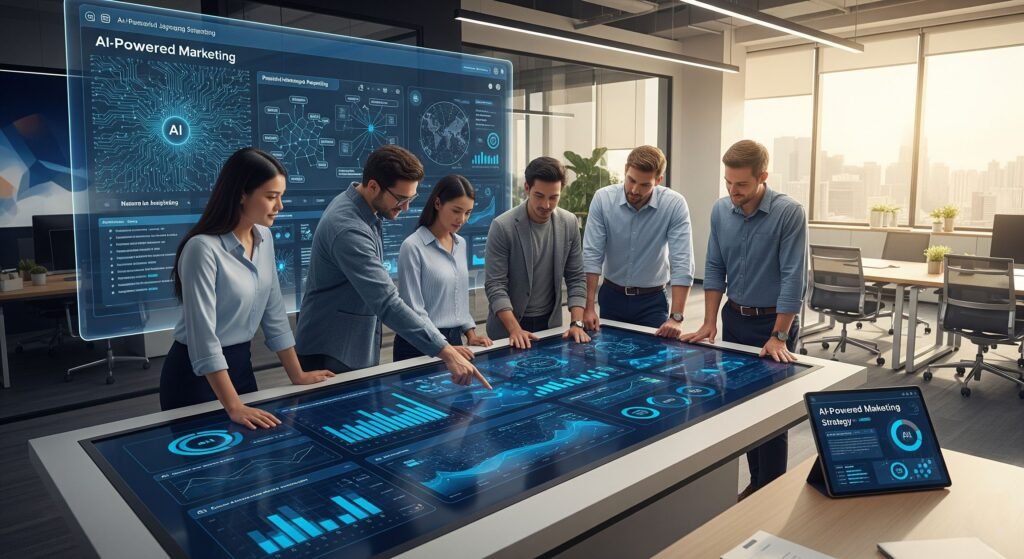
AI Powered Marketing Automation
In 2025, marketing automation isn’t just an operations trick—it’s a high-impact strategist, powered by Artificial Intelligence. By integrating machine learning and predictive analytics, businesses are intelligently optimizing spend, enhancing personalization, and directly impacting ROI.
This article digs into how AI-powered marketing automation is delivering real financial results—from Klarna’s cost savings to hyper-personalization strategies—while pointing to emerging trends and best practices.
AI Powered Marketing Automation
The Power of AI in Marketing: Real-World Wins
Klarna: $10M in Marketing Savings
Swedish fintech company Klarna implemented generative AI tools (Midjourney, DALL-E, Firefly) to automate marketing visuals and campaigns, saving $10 million annually.
- $6 million came from in-house image generation, reducing reliance on agencies and cutting image cycle times from six weeks to seven days.
- A further $4 million was saved by eliminating external agency fees.
- Resulted in an 11% cut in sales and marketing budgets, while increasing campaign output and efficiency.
Inc.comFast Company
Nvidia & Delta: Bridging Ads to Sales with AI
AI Powered Marketing Automation
Delta leveraged AI solutions powered by Nvidia’s spiking neural networks to attribute $30 million in airline ticket sales to its Olympic sponsorship—merging advertising metrics with actual sales performance.
Tools also enabled digital twins and AI-enhanced ad development that improved efficiency and transparency between marketing and supply chain teams.
Business Insider
AI Powered Marketing Automation
The Strategic Shift: How AI Delivers ROI
Hyper-Personalization Drives Engagement
AI enables real-time tailoring—delivering highly personalized experiences across channels. IBM notes it can reduce acquisition costs by up to 50%, while enhancing engagement and loyalty.
TechRadar
Generative AI Speeds Creative Production
AI-generated visuals and campaigns (e.g., Forever 21’s fast-turn campaign) can outperform traditional methods, delivering 66% higher ROI and drastically reducing production time.
Business Insider
Implementing AI: Roadmap to Success
1. Define KPIs Clearly
Start with measurable goals—ROAS, CPA, conversion lift—before automating.
2. Integrate Data Silos
Consolidate CRM, ad platforms, sales data, and creative workflows into unified dashboards for full visibility and seamless AI automation.
3. Pilot & Validate
Phase in AI tools gradually—pilot in one channel or campaign, measure results, then scale.
4. Balance AI with Human Insight
AI Powered Marketing Automation
AI optimizes performance, but humans should drive brand messaging, strategy, and ethical use—preserving authenticity.
5. Track Metrics Beyond Immediate Sales
Track CLTV, multi-touch attribution, customer satisfaction, and automation-driven ROI shifts for full visibility.
Advanced Use Cases: Beyond Basics
Hyper-Personalization in Action
AI-powered platforms allow brands to curate dynamic product suggestions and offers at the individual level—boosting relevance, engagement, and revenue.
TechRadar
Real-Time Content Generation
AI dynamically adjusts email subject lines, landing pages, social copy, and even tweets based on live behavior and sentiment.
Omni Funnel Marketing
AI Powered Marketing Automation
Future Trends: Where AI & Marketing Are Headed post-2025
- Autonomous Campaign Execution: From budget allocation to ad creation, marketing tasks automated end-to-end.
- Voice-Controlled Marketing Adjustments: “AI, shift 20% more to mobile ads.”
- Cross-Media Attribution: Measuring offline marketing (billboards, TV) alongside digital campaigns.
- AI-Originated Creative Bundles: Messaging, design, and spend optimized as one package.
- Ethical Automation: Businesses implement spend limits, transparency, and opt-outs to maintain trust.
FAQ Highlights
Q: Is AI in marketing only for large brands?
Not at all. Small and mid-sized businesses are seeing real gains from intelligent email segmentation, ad bidding, and content automation.
Q: Does AI eliminate creative roles?
No. AI handles performance and testing; human roles evolve toward big-picture strategy and emotional brand storytelling.
Q: How long for ROI?
Typically 2–4 weeks for early gains, with full ROI seen in 3–6 months after proper setup and iteration.
AI Powered Marketing Automation
How AI Drives Marketing ROI
AI’s ability to process and analyze massive amounts of data in real time is the key to its effectiveness. It goes beyond traditional automation, which simply executes predefined rules. AI learns, predicts, and optimizes campaigns on the fly, leading to more intelligent and impactful marketing. Here are the core ways AI drives ROI:
- Hyper-Personalization: AI algorithms analyze customer behavior, preferences, and purchase history to create highly tailored content, product recommendations, and ad experiences. This level of personalization significantly increases engagement and conversion rates.
- Predictive Analytics: AI can forecast future customer behavior, such as which leads are most likely to convert or what products a customer is most likely to buy next. This allows marketers to allocate resources more effectively and target the most promising opportunities.
- Real-Time Optimization: AI can automatically adjust ad bids, content delivery times, and marketing channels in real time based on performance data. This ensures campaigns are always running at peak efficiency, minimizing wasted spend and maximizing results.
- Automated Content Creation: Generative AI tools can create everything from email copy and social media posts to ad creatives and video scripts, all in a fraction of the time it would take a human. This boosts productivity and allows marketers to produce more content at a lower cost.
AI Powered Marketing Automation
Klarna’s Real-World Success Story
One of the most powerful examples of AI’s impact on marketing ROI comes from the fintech company Klarna. In a recent campaign, Klarna used generative AI to automate its marketing functions, leading to significant cost savings and increased output.
By leveraging AI for image generation, copywriting, and campaign management, Klarna was able to save an estimated $10 million annually on marketing costs. This included a 25% reduction in spending on external marketing agencies and a drastic decrease in content production timelines, from six weeks down to just seven days. This case study demonstrates how AI can make marketing departments leaner, faster, and more responsive while simultaneously increasing the volume and quality of their campaigns.
AI Powered Marketing Automation
Emerging Trends & The 2025 Outlook
AI Powered Marketing Automation
The future of AI-powered marketing automation is already here, with several key trends shaping 2025:
- Multimodal AI: AI systems are evolving to process and generate content across multiple modalities, including text, images, audio, and video. This will lead to more integrated and dynamic campaigns that can engage consumers on a deeper level.
- Advanced Conversational Marketing: Beyond basic chatbots, AI-powered conversational tools will become more sophisticated, capable of understanding complex user intent and providing personalized, human-like interactions across customer service and sales.
- Ethical AI and Data Privacy: As AI becomes more integral to marketing, the focus on ethical use and data privacy will intensify. Businesses will need to implement robust governance frameworks to ensure transparency and build customer trust.
- AI-Enhanced Human Roles: Rather than replacing marketers, AI will act as a co-pilot, automating repetitive tasks and providing data-driven insights. The future of marketing will be a collaboration between human creativity and AI-powered efficiency, freeing up professionals to focus on strategic thinking and innovation.
By embracing these trends, marketers can not only future-proof their careers but also drive unprecedented ROI and create more meaningful connections with their audiences.
AI Powered Marketing Automation
AI Powered Marketing Automation
Conclusion
AI-powered marketing automation is transforming how marketing budgets are optimized in 2025—from design to delivery, spend to strategy. With key wins like Klarna’s cost savings and Delta’s real campaign-to-sales attribution, the technology is proving its value every day.
Marketing leaders who leverage AI not only save cost—they elevate precision, scalability, and creativity. The future belongs to those who embrace AI as both an enabler and a partner—not a replacement.
Would you like me to also prepare a navigation list of recent news sources to highlight these findings?
check our latest post👇
How Marketing Automation Streamlines Customer Onboarding in 2025
AI Chatbots in Marketing: Boosting Customer Engagement in 2025
growbhai247Introduction to AI Chatbots in Marketing AI chatbots in marketing Marketing in 2025 looks very…
Generative Engine Optimization (GEO): The Future of SEO in 2025
growbhai247Introduction Generative Engine Optimization (GEO): The Future of SEO in 2025 Generative Engine Optimization The…
AI-Powered CRM Software for Modern Businesses: The Future of Customer Relationship Management
growbhai247AI-Powered CRM Software for Modern Businesses: The Future of Customer Relationship Management Introduction In today’s…
Maximizing ROI with AI Powered Marketing Automation: Real-World Insights & Future Outlook
growbhai247Introduction AI Powered Marketing Automation AI Powered Marketing Automation In 2025, marketing automation isn’t just…
How Marketing Automation Streamlines Customer Onboarding in 2025
growbhai247Introduction Marketing Automation Streamlines Customer Onboarding First impressions matter in business. When a customer signs…
The Future of AI Powered Email Marketing: Strategies for 2025
growbhai247Introduction AI powered email marketing Email marketing remains one of the most powerful channels for…
